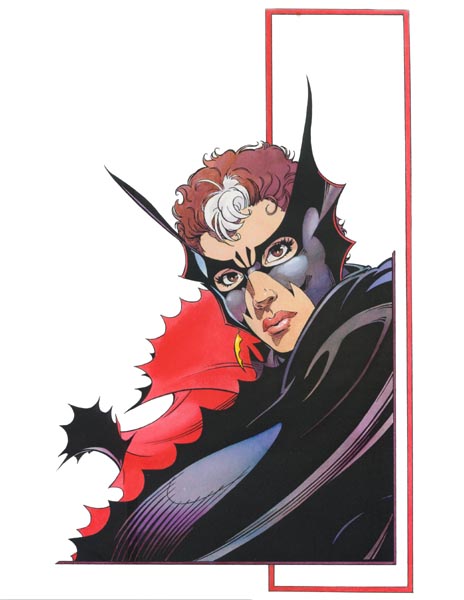
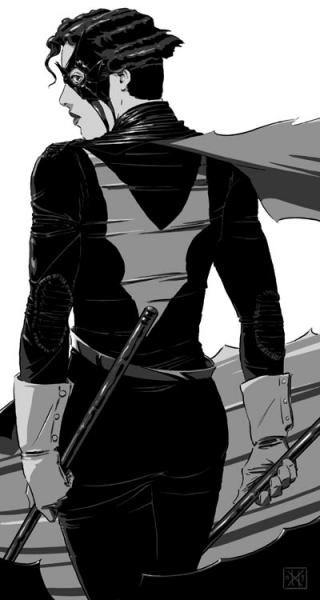
Margarita Lucinda del Socorro (nicknamed "Mega" by her older sister Eva) was born with an exceedingly sensitive hyper-developed sense of hearing which often left her confused and very introverted. She was often labeled through school as having an undiagnosed learning disability. This continued as she grew older, causing Mega to grow up as an extreme introvert and socially very awkward and naïve. After befriending a kindred spirit who recognized her situation (Camilla Conde), she soon found an awakened confidence and desire to define herself and her place within her community in the largely Hispanic neighborhoods of Los Angeles.
Shortly after graduating high school, she was approached by Soliloquy Jones representing a man only known as "Sifu", who invited her to look into training with him at his martial arts school. Hesitant at first, she eventually went and soon met the other students there, some "different" like her. She joined the school and in time became part of a team of heroes known as the Reiki Warriors.
In the new Studio G continuity as we relaunch, our intention is for our characters to age roughly in time with the real world. Given that Mega was born in 1968, we will merely say for the moment that this will be explained in her 40th Anniversary story which will both establish the new Studio G continuity going forward while also preserving the past "Dærick Sr. era" as canon.
WHAT'S IN A NAME?
Is it Murciélaga or She-Bat or Murciélaga She-Bat or even Murciélaga, the She-Bat? What's going on here?
Honestly, it is pretty interchangeable. Primarily, the character is known as Murciélaga though She-Bat is just as valid. For titling and character identification purposes we at Studio G more formally refer to her as Murciélaga She-Bat and occasionally you will erroneously find that with a comma added in. To be clear, there is no "The" used when referencing the character.
Longtime fans will note that Murciélaga's civilian name has seen some changes over the years. Her name was originally given as Mega Vergas, a juvenile play on words meant to be cheeky for a minor side character; at the time she was not expected to step out of her supporting role. Since then her last name has changed a couple times and has landed on del Socorro to reflect a more serious, realistic identity. Her first name "Mega" is a nickname for her full name Margarita. In 2001, a promo video was made as a pitch to license the character out to a live-action format. For this iteration only, her named was changed to Erika by the production agency, along with some other changes.
Let's Recap | The First 40 Years...
THE FIRST DECADE
Murciélaga is the creation of Studio G's Dærick Gröss Sr. Initially intended to be simply a supporting character, Murciélaga very quickly found herself starring in her own short stories. In the late 1980s, CFW Enterprises published a series of magazines featuring comic book short stories geared towards a martial arts readership and fanbase. It is here where Murciélaga and Studio G's other characters were born.
With the end of the CFW comics run in 1989 and a heavy workload with Innovation Comics on The Vampire Lestat, D Sr. placed Murciélaga and the rest of Dragon West's entourage on hiatus for a couple of years. In 1992 Heroic Publishing picked up Murciélaga as an imprint, and by the end of the year Murciélaga She-Bat #1 was in circulation with a January 1993 print date. This first issue was a reprinting of two stories from her Robowarriors days, meant as a reintroduction of the character to a broader, general comic-reading audience. Issue #2 (April 1993) was a new story, a crossover tale featuring Heroic's character Tigress (and establishing that this iteration of Studio G characters co-exist within the same universe as Heroic's), and gave her a costume change that has solidified her look ever since.
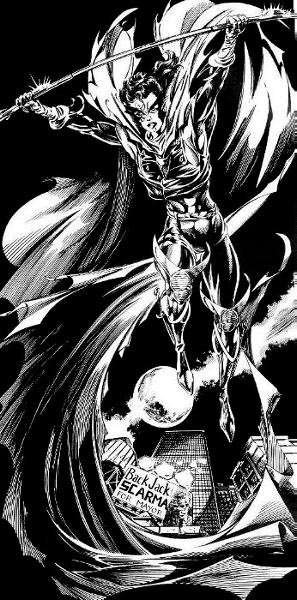
The 90s also brought Studio G to the internet, and by 1996 there was not only a web presence for the studio but also a home for Murciélaga specifically. After the "Rings For A Demon" prologue stories ran their course in Heroic books and culminated in Reiki Warriors #1 through Revolutionary, She-Bat was largely relegated to spot appearances and her online community. By the end of the 1990s, the time was ripe to reinvigorate her as a character.
A NEW CENTURY
In 2001, Studio G released a 3-issue mini-series relaunching She-Bat. This release was notable for being a bilingual flipbook, and was very well received by the comics industry as whole, with fans and critics alike applauding both her return and the clever publication twist. Three stories were published (one being a reprint, the other two were brand new), both in English and Spanish. In each book, one story reads through half way, then flips over to reveal one of the other stories in the other language. Different covers adorned each side as well. To have all three stories in both languages, one needed to collect all three books.
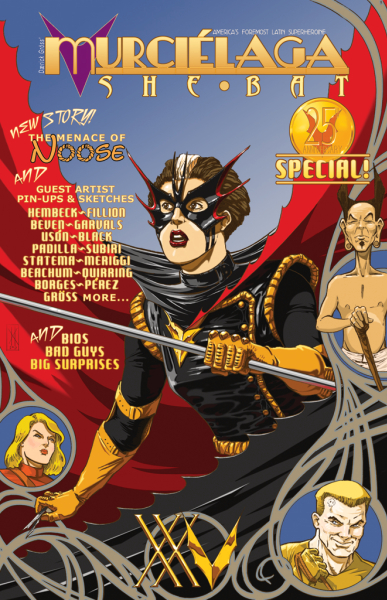
THE END OF AN ERA
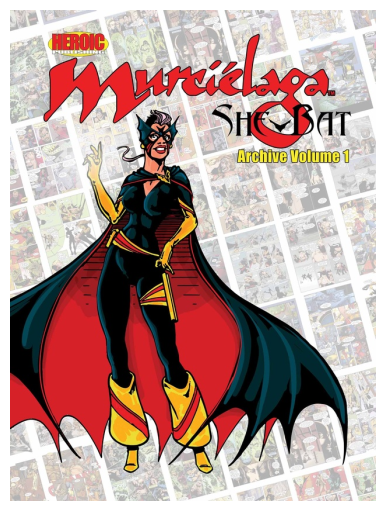 In the wake of the fire, Studio G as a whole limped along for a few years. Eventually Dærick Sr. regained his footing in the comics space and partnered with both AK Comics and Heroic for She-Bat to make appearances in other books, and to return to her own ongoing title as an imprint, though those stories were primarily reprints. This kept the character alive through the 2010s and into the 2020s, right up to the end of Dærick Sr's life.
With Dærick's passing in late 2023, this era of both Murciélaga and Studio G as a whole came to a close. As of 2025, the studio is now fully in the hands of Dærick W (DW) and a full relaunch in the works. Studio G has partnered with Heroic Publishing and Critical Blast to produce a complete omnibus of every She-Bat story from the Dærick Sr. years. This entire phase of the character's life is considered Volume 1 and will be maintained as canon, even as we reinvent things for a new, future audience with Murciélaga's 40th Anniversary relaunch (targeting summer of 2028).
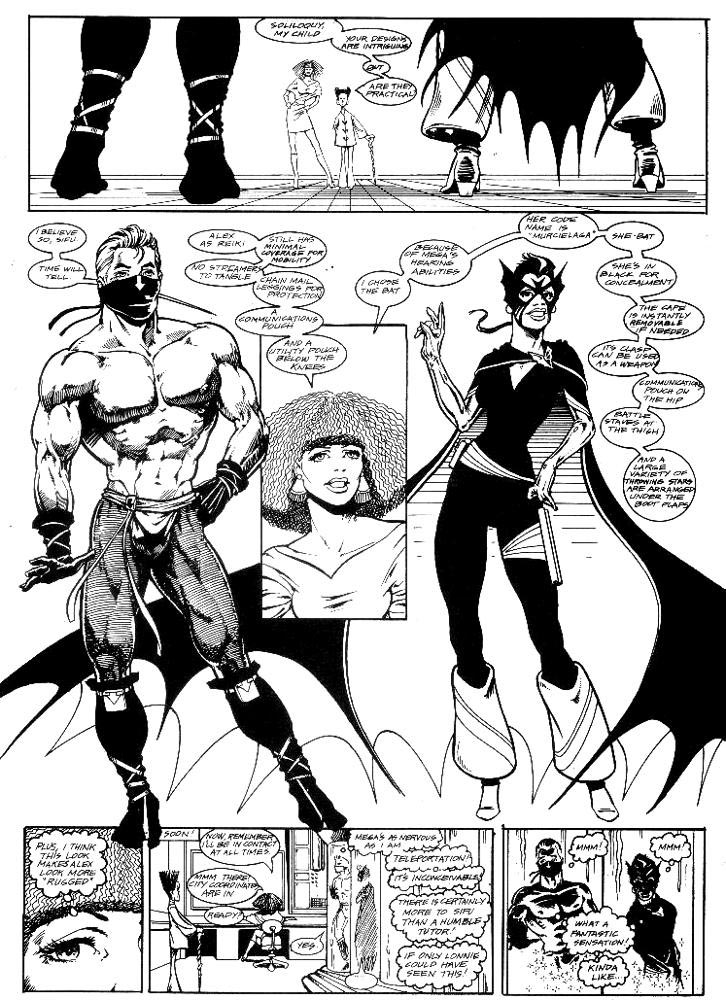
In 1988, CFW began publishing a magazine titled Robowarriors. In issue #1, Dærick Sr. introduced some the major elements that would become mainstays of Murciélaga's story and environment. Alex (Reiki, later known as Mr. No), Sifu, and the Dragon West School for Martial Arts are established, as well as Sifu's enigmatic background and penchant for rock band t-shirts. Murciélaga first appeared in issue #3 of Robowarriors (June 1988), introduced with Soliloquy Jones as new students at the school. From this first appearance, Murciélaga soon became a regular character in the magazine as both a supporting player in other stories and as the lead in her own. Over the next year and a half her appearances increased, right up to the demise of CFW's publications at the end of the 80s.
While many of the story elements introduced during the "CFW period" have remained an integral part of her history, these stories are not specifically considered canon in the Studio G comic continuity.
By 2000, Studio G refocused on comic book property development, and Murciélaga was at the forefront of that vision. The decision was made to offer the character up for potential cross-media licensing to see what other opportunities may be open for her. Super heroes were en vogue at the time on television, and there was interest from more than one Spanish-language channel to find an original property to develop. Partnering with Design Concepts (in association with Man Of Action), a promotional short for Murciélaga was produced in early 2001 in both English and Spanish. Since Design Concepts is now defunct, we've digitized our own VHS copies of these shorts and the 1-minute "trailer cut" to make them available here for you to enjoy what could have been...
...and yes, that is John Taylor of Duran Duran in the short.
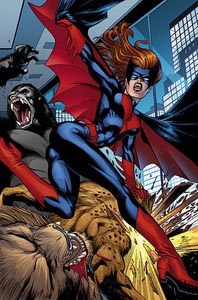 There's no getting around this conversation, it has come up for for nearly forty years now. Neal Adams and Continuity Comics also have a She Bat, and she came out at just about the same time as Murciélaga. DC Comics has Batwoman, and let's be honest here, they have everything "bat". So where does Murciélaga fit in to this? We're often asked if there are IP conflicts here or if we have ben entangled in legal battles for years.
Fortunately, it isn't that complicated. There isn't any real compromise or conflict here, and Murciélaga hasn't had any serious challenges as a character (which we are very grateful for). Let's start with Valeria and Continuity Comics... The only real overlap in this case is just in the name "She Bat". Since both characters have a different primary name they go by, and the characters and market are so different there really wasn't any problem. Dærick Sr. and Neal had a discussion or two early on and agreed there wasn't a concern to trouble over.
Regarding Batwoman and the whole "bat" thing... Dærick Sr. has stated in interviews that back in 1988 when Murciélaga was created, she was inspired by the original 1950s Batwoman as well as Dærick's lifelong love of comics in general. The intention was to create a strong female heroine at a time when there were very few in comics that weren't overtly sexualized or diminished in some way. As the character was taking shape, D Sr pulled from inspiration all around him... Living in Los Angeles, the Hispanic angle was very influential. The "bat" theme was powerful, but daunting due to the legal ramifications of a misstep with DC. The decision was to give her a hyper-hearing ability, which became part of her story in overcoming the dysfunction that brought to her life. This allowed for a grittier background story than the candy-color days of the 1950s inspiration. This also helped to define her as a character very different from DC's Batman mythos where the characters do not have super powers of any kind. Her bat theme is a natural extension of her abilities. Her story and use of character is completely different from characters in the DC universe. Conversations between D Sr. and Dennis O'Niel and DC in the early 90s when D Sr. was doing some work for them cleared up any potential legal concerns. It was decided there was no infringement on the intellectual property, and Murciélaga was free to see print and develop.

 Find Murciélaga on